How Scoring Works — Double Trouble
Hong Kong scoring runs on faan, and faan run on doubling: each faan doubles the payout (2 to the power of your faan), capped at the 13-faan limit — the famous 例牌. Most tables ask for a minimum of 3 faan before you may declare a win. Limit hands score the cap outright and ignore the small change. Two common house rules ship as switches: half-spicy payouts and a 10-faan cap.
The Limit Hands — The Cap, Full Stop
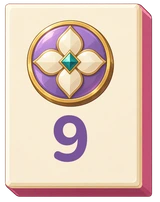
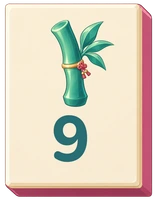
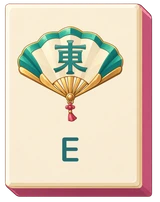
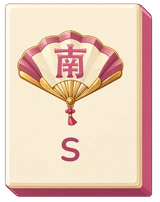
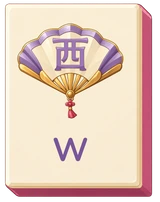
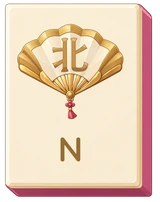
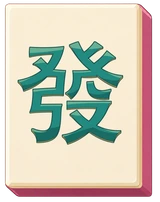
Great Winds (limit): pungs of all four winds. Small Winds (limit): pungs of three winds plus a pair of the fourth — the classic 6-faan pricing is a table switch. All Honor Tiles (limit): winds and dragons only. All Terminals (limit): pungs of 1s and 9s only. Self Triplets (limit): All Pungs with every triplet concealed — a discard may only complete your pair. All Kongs (limit): four kongs plus a pair — the Eighteen Arhats. Thirteen Orphans (limit): one of every terminal and honor, pairing any of them. Nine Gates (limit): the concealed 1112345678999 masterpiece. Heavenly Hand (limit): the dealer wins with the dealt hand. Earthly Hand (limit): a non-dealer wins on the dealer's very first discard.
The Big Faan — Flushes and Dragons
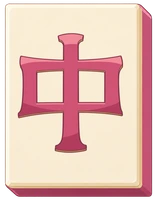
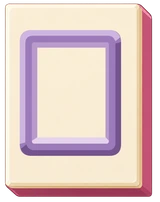
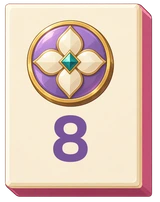
Great Dragons (8): pungs of all three dragons — eight faan all in, dragon pungs included. Pure One Suit (Full Flush) (7): one suit, nothing else. Small Dragons (5): pungs of two dragons plus a pair of the third, dragon pungs included. Seven Pairs (4): seven concealed pairs. All Pungs (3): every set a pung or kong. Mixed One Suit (Half Flush) (3): one suit plus honors.
The Singles — One Faan at a Time
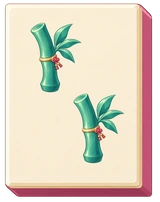
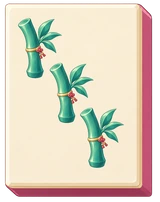
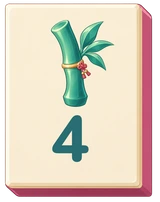
Common Hand (1): all sequences — the runner's special. Pung of Dragons: 1 for each dragon pung. Pung of Seat Wind (1). Pung of Prevailing Wind (1) — a wind that is both counts twice. Mixed Orphans (1): every pung and the pair from 1s, 9s and honors — All Pungs stacks on top. Flower/Season of Seat (1 each): your own seat's bonus tile — the flower and the season both count; off-seat tiles score nothing. All Flowers / All Seasons (2): the complete quartet of either series. No Flowers at all: also 1 — the game pays you either way.
Win Context — How You Crossed the Line
Self-Pick (1): you drew the winning tile. Win from Wall (1): the hand was concealed. Robbing the Kong (1): you claimed the tile someone was promoting to a kong. Win by Last Catch (1): the wall's final tile — drawn or discarded. Win by Kong (1): the replacement tile after your kong, self-pick on top. Win by Double-Kong (8): a kong declared on a kong replacement, then the win — lightning twice. In live play these fill in automatically; from a photo, set them by hand.
Payouts and House Rules
Win off a discard and the discarder pays the whole amount alone. Self-draw and all three players pay half the amount each — one-and-a-half times the table value in total. Half-spicy: an optional gentler table — above 4 faan the payout doubles every TWO faan instead of every one. 10-faan or 8-faan limit: optional lower caps for friendlier stakes. All switches live in the ruleset settings and travel with your table, so every seat scores alike.
Sources & scope
This reference describes the rules implemented in Hé Fēn; an event’s own rulebook takes precedence at that event. Reference links checked 13 September 2026. We are not affiliated with these organisations.
- Hong Kong New Style in Hé Fēn Hé Fēn Mahjong. The specific New Style scoring table used here. Hong Kong Old Style and local tables may use different minimums and payments.