Tile efficiency
You still need five sets — but now they have to clear a floor, so shape quality buys value, not just speed
Prioritise multi-sided waits
BEGINNERFavour shapes that complete from multiple draws. A two-sided sequence (4-5 waiting on 3 or 6) can be finished by up to 8 tiles; an edge wait (1-2 waiting on 3) by at most 4. With five sets to build and a minimum to clear, the wide shape is worth even more here than in the no-floor Classic game — a fast but shapeless hand can arrive under the floor and be worth almost nothing.
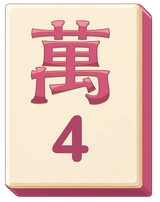
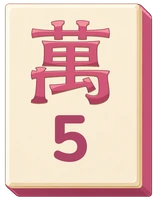
Completes on 3m or 6m — up to 8 tiles live.

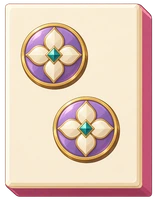
Completes only on 3p — 4 tiles at best.
Flowers are free money — complete the set
HOUSE SHEET BEGINNEROn the club sheet a completed flower set pays immediately, straight across the table, whether or not you go on to win: a mixed set (one of each number 1–4) collects 5 from EACH player, a pure set (all four of one colour) collects 10 from each. Your flowers auto-set-aside and draw a replacement, so they never cost you tempo — but the set is a genuine points event. When you are sitting on three of a set, the fourth is worth chasing a beat for.
The concealed gong pays here — declare it
HOUSE SHEET INTERMEDIATEUnder Classic scoring a kong is a coin flip (see the Lab, below). The club sheet changes the premise: declaring a concealed gong collects 5 from EACH player the instant you show it — 15 points banked before the hand is even decided — on top of its scored value. A safe fourth tile of your own pong is not a neutral draw here; it is a paid action. (Just remember the flip side: a concealed gong you fail to reveal at game end pays 10 to each player.)
Value vs the floor
The rising minimum is the whole game — a hand that does not clear it barely scores
Know your floor — and that a chicken hand is NOT a weapon here
HOUSE SHEET BEGINNERThe minimum to declare rises with the round: East 20, South 22, West 24, North 26. A win worth almost nothing is a Chicken Hand, floored to 20 (the app warns; some tables block it outright). This is the exact opposite of Classic, where a shapeless zero-value win is a real tactic — here it barely clears the minimum and is often illegal. Build a hand with genuine value: a flush, a pong hand, a couple of scoring pairs.
Bank the table transfers — points that do not need a win
HOUSE SHEET INTERMEDIATEBecause kong and flower bonuses settle straight across the table, a hand that never wins can still turn a profit: a pure flower set (10 from each = 30) plus a concealed gong (15) is 45 points banked with no mahjong at all. When you are folded out of the race, you are not out of the money — keep completing your paid events while you defend.
The ceilings are the big shapes — Nico Nico and the Orphans
HOUSE SHEET ADVANCEDOn a flat-points sheet the top of the table is the special hand: Nico Nico (seven pairs) scores 50 — 75 with two undeclared gongs inside it — and 16 Orphans stacks its terminal bonuses on top. These are the hands that clear the North floor with room to spare and win a session. When a deal leans pairs, Nico Nico is a real target, not a curiosity.
Never misdeclare — the false-mahjong fine is brutal
HOUSE SHEET ADVANCEDA false mahjong pays 25 to EACH player — you lose 75 in a single mistake, more than most winning hands make. Before you declare, be certain the hand is complete AND clears the round floor. On the club sheet the discipline of not declaring early is worth as much as any building tip: one false call can erase an evening.
Defensive play
Dodge the ron, deny the draw — and watch the mid-game penalties
Do not lead a chase on a live tile
HOUSE SHEET INTERMEDIATEThe sheet fines chasing: if all four players discard the same suit tile in one round, the FIRST discarder pays 10 to each (an honor tile, 5 to each). When a tile has already been thrown twice and looks safe all round, being the fourth is fine — being the one who STARTED the round on it can cost you. Read the round before you lead with a fresh tile.
A cheap ron still clears their floor — respect a ready opponent
INTERMEDIATEThe floor cuts both ways: an opponent who looks ready only needs a hand that clears their own round minimum, and the sheet's base plus a pong or two gets there easily. Do not assume a modest-looking hand is harmless — against exposed pongs in one suit, or exposed honors, defend as you would against any real hand.
Folding still cannot save you from the self-draw
ADVANCEDPerfect defence dodges only the discard win — a self-draw collects regardless of how safely you played. Against a big visible hand, safe discards are half the job; the other half is denying draws (claim tiles to break the rhythm) and, when you cannot win, banking your own transfer points while you shorten the hand toward the wall.
Reading the table
Declarations and discards are public — the club sheet gives you extra tells
Watch the declarations, not just the discards
HOUSE SHEET INTERMEDIATEOn this sheet players ANNOUNCE paid events — flower sets, concealed gongs. Each one tells you a seat is banking points and, often, how their hand is shaped (a concealed gong means three of a kind already down and a replacement drawn). Track who is quietly profiting from transfers even when nobody has won.
Two discarded suits can hint at a flush
INTERMEDIATERepeated dot and character discards, with few bamboo discards, may suggest a bamboo flush. Compare that clue with exposed sets and the club sheet’s qualifying minimum before choosing a discard.
Advice and evidence
A strategic suggestion depends on your hand, opponents and scoring sheet. Older simulation summaries do not establish an optimal action. Our latest matched-deal batch reports uncertainty and includes inconclusive results.
Compare strategy across rulesets →
The same shape can lead to a different decision under a different scoring system.